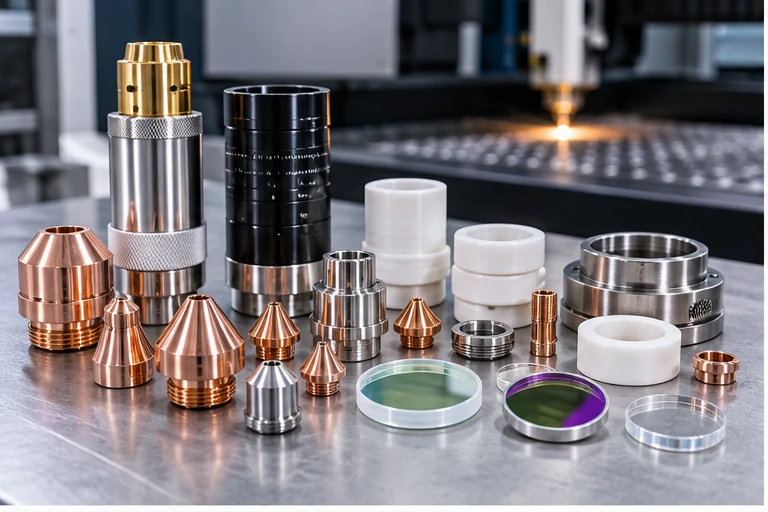
The nozzle shapes the assist-gas jet, centering aligns that jet with the beam path, standoff controls nozzle-to-sheet distance, and focus position changes energy distribution in the kerf. Treat them as separate checks.
Nozzle
The cutting nozzle is part of the gas-delivery system. Its diameter and internal geometry influence gas flow. Damage, contamination or a non-concentric orifice can disturb the process even when the laser source is healthy.
Centering
Beam/nozzle centering confirms that the laser path is concentric with the nozzle opening. If centering is poor, gas flow and heating can become asymmetric, which can show up as directional differences in edge quality or nozzle heating.
Standoff
Standoff is the nozzle-to-workpiece distance controlled by the height-sensing system. It must be stable. A bent nozzle, dirty ceramic, grounding problem or sensor issue can upset height control.
Focus position
TRUMPF notes that focus position influences irradiance and kerf form. Focus is therefore not simply “always zero”; the correct setting depends on material, thickness, process and machine technology table.
What to record after a successful test
- Material and thickness.
- Nozzle type/diameter.
- Gas and pressure.
- Focus setting/reference.
- Speed and power.
- Observed kerf/burr/edge quality.
This article is general guidance for preliminary engineering and shop-floor understanding. The drawing, applicable standard, machine/tooling OEM instructions, process-specific safety requirements and qualified engineering judgment take priority.